

Suman Chandra ’22 MEM still has a Yale sticker on her laptop and, while at the 2025 United Nations Climate Change Conference in Brazil, which she attended in early November as a climate negotiator on India’s behalf, the sticker was an instant conversation starter among dozens of alumni in attendance. She is currently working as Director to the Government of India in the Ministry of New and Renewable Energy.
“It feels like a family,” says Chandra, who graduated from the Yale School of the Environment (YSE), of the network she formed on campus.
This particular family is confronting a daunting task: helping the world meaningfully address the current and future effects of climate change. The conference—this year’s was known as COP30—is the world’s annual effort to enforce the 2015 Paris Agreement, which aims, among other goals, to limit the global average temperature rise to 1.5 degrees Celsius above pre-industrial levels.
Yale was well represented. Several faculty were in attendance, as were groups of undergraduate and graduate students, some of whom worked with country delegations or staffed a booth coordinated by Yale Planetary Solutions and YSE that highlighted climate-related work across the Yale community. In addition, more than 50 alumni from YSE and the Jackson School of Global Affairs were involved in discussions and negotiations on behalf of governments and nonprofit organizations.
Here is a snapshot of two of those alumni and their roles at COP30:
Suman Rawat Chandra ’22 MEM
 Before she attended YSE, Chandra worked in a variety of roles at the state and national level in India, including helping implement a World Bank program that aimed to increase entrepreneurship among women. She saw some of the impacts of the climate crisis firsthand, including drought and other associated social repercussions.
“We were doing this bandage solution providing,” she says. “I realized I needed to understand the problems better and deeper for tangible solutions.”
Since 2023, she has been working on her country’s efforts to fight climate change, including on initiatives to increase solar power in the agricultural sector and at the household level. At COP30—her fourth such conference—she has been involved in a variety of negotiations, including for the United Arab Emirates Just Transition Work Programme and Mitigation Work Program.
YSE was a “very transformational experience,” she says. “It equipped me with the right technical knowledge and a shared global vocabulary without which it would be difficult to function” in the climate space.
Felipe Storch de Oliveira ’25 MEM
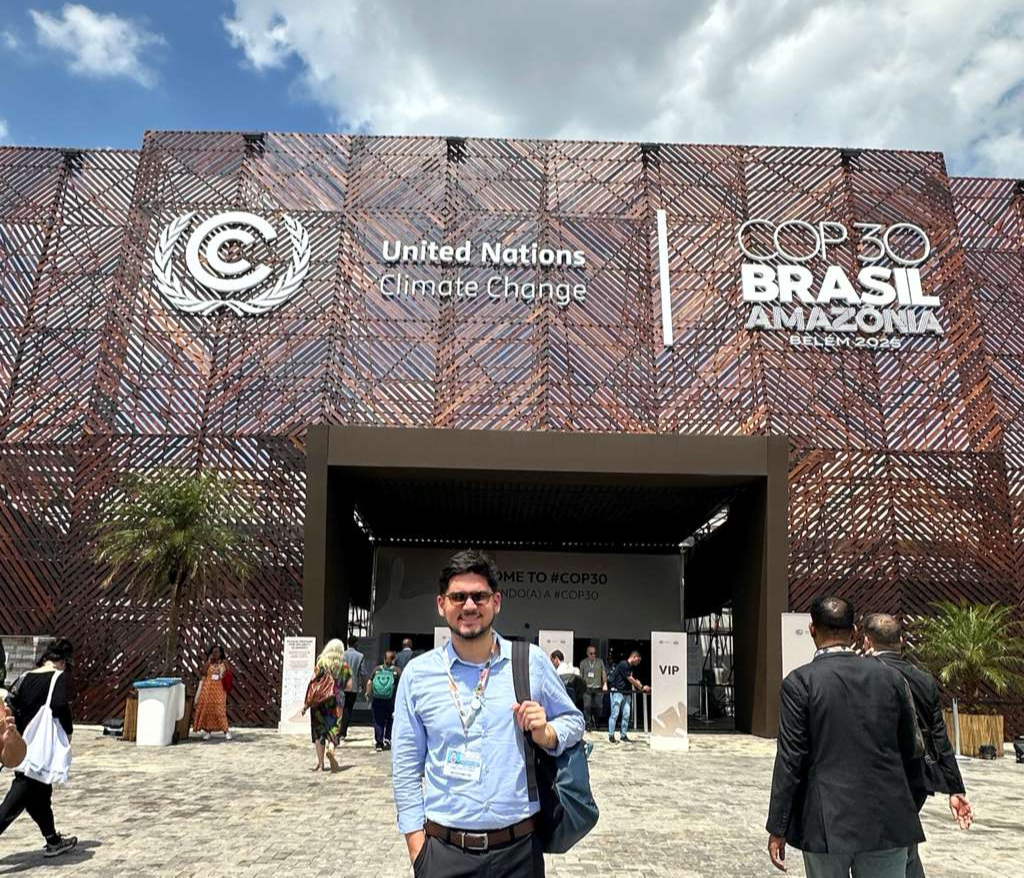 Felipe Storch de Oliveira ’25 MEM, a consultant with the Inter-American Development Bank (IDB), is helping support his native Brazil in its implementation of the Tropical Forest Forever Facility, which would make annual payments to tropical countries that preserve their forests through an investment mechanism.
Working with Brazil’s Ministry of Environment and Climate Change, Storch de Oliveira spent his time at COP30 organizing high-level meetings with government leaders and representatives to discuss how the future funding can be used to support people conserving tropical forests on the ground.
“We have to use different funding tools so that economic agents understand that a standing forest is worth more than a destroyed forest,” he explains.
Storch de Oliveira attended YSE after working for several years with nongovernmental organizations on issues related to the Brazilian Amazon, including bioeconomy products, forced migration, and the COVID-19 response.
“All of them were basing their programming on available foreign aid and donations, which were and are extremely important but do not reach the funding scale necessary to make large-scale change,” he says. “I wanted to take a step back and see other ways of influencing change.”
At YSE, Storch de Oliveira took influential courses with YSE Professors Paulo Brando (who was also at COP30) and Eli Fenichel, among others. The lessons he learned there now inform his work on behalf of Brazil and communities in the Amazon.
“I try to think of people in the Amazon that might not have the power to influence systems and organizations,” he says. “They are not vulnerable persons, but they have been made vulnerable because of this intense process of a warming planet. To finance forest conservation is to guarantee their means of subsistence and protect our collective future.”


